FROM http://noeticindia.blogspot.com
SCIENCE OPENS TO MAN new vistas of freedom. It liberates him from the blind fanaticism of the middle ages which often still finds expression in him. Science looks at the world objectively and draws certain conclusions from the available data. It, however, recognizes the fact that these conclusions are not absolute, because new information from newer data modifies or even rejects the earlier conclusions. This steady search for new facts and the constant readiness for its own reformation is the basic spirit of modern science.
But, even for the scientist it is sometimes difficult to adopt this right spirit of science. For, man is very much limited by his mental horizon and a breakthrough is a painful process. Carl Jung, the renowned psychologist, highlights this dilemma of the scientist: "Even a scientist is a human being. So it is natural for him like others to hate things he cannot explain. It is a common illusion to believe that what we know today is all we can ever know? History of modern science has many glaring examples of how even eminent scientists stood on the way of the advancement of scientific knowledge by condemning new, bold, concepts and experiments.
Rishi and the Scientist
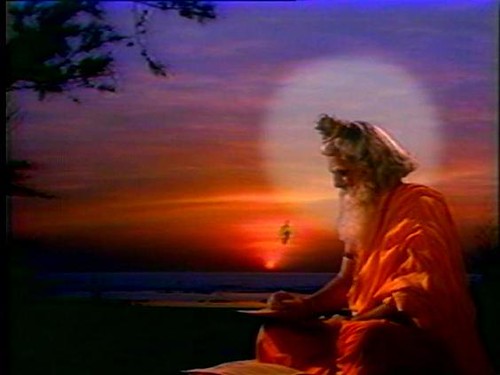
Superstitions, of course, have always grown around knowledge. A modern man who thinks that by his advanced stage of scientific knowledge he can give a rational explanation to the universe is as superstitious as a primitive man who follows blindly his traditional customs. But, in every phase of human history there emerge adventurous explorers of knowledge, and to our amazement we find that they have much in common whether they lived in some very remote age or in our own century.
It is the free spirit of inquiry and the common fields of agreement that link the ancient Rishis of India with the scientists of the modern age. In some of the utterances of top physicists like Einstein, Max Planck, Heisenberg, and others we near the echoes of the words of the Upanishadic sages who lived thousands of years ago.
Stepping Beyond the Senses
The special character and approach of modern science originated around the sixteenth century. In the words of Francis Bacon, one of the founding fathers of modern science, it was a revolt against a jumble of "unsound doctrines based on all sides by vain imaginations". Man can establish progressive stages of certainty about nature through the evidence of the senses helped and guarded by certain processes of correction - this is in brief the basic philosophy of science. Eventually science discovered that the range of the human senses could be considerably increased with suitable devices. It acquired new instruments - for instance, the electron telescope, the electron microscope, etc, - which opened stupendous vistas unknown to man's ordinary senses.
 This extension of senses by external instruments is of great importance, which convinced the scientists that there are many things in the universe unknown to the senses. With more sophisticated instruments they found that more subtle facts of the universe could be known. This Rishi explorers of
 yore discovered that man himself possessed many internal means by which he could develop the power of his senses to unlimited ranges transcending their ordinary scope, coming face to face with the deep truths of life and the universe.
We see the ancient Rishis and the modern scientists thus reaching a meeting point although they travel through diverse paths of enquiry. While the scientists made external instruments to extend the human senses, the Rishis discovered that mind itself has more powerful internal instruments which, when called into functioning enabled the seeker to delve deep into the truth of things. Compared. with these, internal faculties, they said, the external senses were extremely limited in their range. And, today we see science itself is stepping into the very exciting field of extrasensory perceptions, the mysterious faculties of human mind which were known to the sages from time immemorial.
This, of course, is a natural development of the scientific enquiry. The 'solid universe' of the nineteenth century physics melted into waves and fields of the twentieth century scientific vision. Starting directly from 'sensuous perceptions' science has reached such a stage that today it tends to ask a most startling question: "Where has the objective world vanished?" The new trend of science shows greater interest in the nature of human consciousness.


